

Shopify defines agentic commerce as the evolution of online shopping where AI assistants like ChatGPT, Google AI Mode, Gemini, and Microsoft Copilot do more than suggest products. They actively help shoppers compare options, answer questions, and complete purchases without ever leaving the chat interface. For consumers, this feels faster and more intuitive. For brands, it unlocks a powerful new sales surface where intent is already high and friction is dramatically lower. To make this possible at scale, Shopify has been building a new technical and commercial foundation designed specifically for AI-native shopping.
Shopify’s foundations for agentic commerce
Rather than launching a single feature, Shopify has created a connected system that allows brands to participate in AI-driven commerce in a controlled, scalable way. This system is built on three core components.
Universal Commerce Protocol (UCP)
The Universal Commerce Protocol is an open standard, co-developed with Google, that allows AI agents to interact directly with real commerce infrastructure. Through UCP, AI assistants can:
Query live product catalogs
Initiate and manage checkout sessions
Apply discounts and loyalty credentials
Complete payments securely
For brands, the benefit is significant. AI agents can now move seamlessly from recommendation to transaction using standardised, secure workflows rather than brittle integrations or affiliate-style redirects.
Shopify Catalog
Alongside UCP, Shopify has introduced the Shopify Catalog. This is a global, machine-readable repository of product data designed specifically for AI discovery. Product information is:
Standardised and normalised
Enriched with structured attributes
Made accessible to participating AI platforms
This allows AI agents to understand products properly, compare them accurately, and recommend them with confidence. For brands, it means visibility wherever AI shopping experiences exist, not just on their own sites.
The Shopify Agentic Plan explained
The Shopify Agentic Plan turns Shopify’s technical foundations into a practical growth channel for brands. It allows merchants, including those without a Shopify storefront, to sell directly inside AI-driven shopping experiences.
With the Agentic Plan, brands can:
Upload and standardise their product data once
List products into Shopify’s global Catalog
Enable discovery inside AI assistants
Allow direct checkout inside conversational interfaces
Sell without operating a traditional Shopify online store
In simple terms, the Agentic Plan lets merchants plug into AI discovery and AI checkout using Shopify’s infrastructure, without migrating platforms or rebuilding their ecommerce stack.
This lowers the barrier to entry for AI commerce and allows brands to capture demand at the exact moment shoppers are asking for help. The plan is currently launching via waitlist, with merchants able to register interest ahead of wider availability.
How agentic commerce works in practice
Connecting to Shopify Catalog
Everything starts with product data. Merchants upload structured product information to Shopify once. From there, Shopify:
Enriches and normalises product records
Makes them queryable by AI agents
Syndicates them across supported AI platforms
High-quality data plays a critical role here. AI agents rely on this information to generate recommendations, answer follow-up questions, and present products accurately. Brands with richer, more complete data gain a clear advantage in AI-driven discovery.
Agentic storefronts for Shopify merchants
For brands already using Shopify, agentic commerce is enabled through Agentic Storefronts. These appear as a new sales channel within Shopify admin and allow customers to complete purchases directly inside AI interfaces. From a merchant perspective, this looks and behaves like any other Shopify channel:
Orders appear in Shopify admin with full attribution
Merchants remain the merchant of record
Customer relationships and post-purchase experience stay with the brand
Merchants also retain control. They can choose which AI platforms to participate in and decide which products are eligible for direct checkout, allowing them to adopt agentic commerce at their own pace.
Secure checkout via UCP
Behind the scenes, the Universal Commerce Protocol manages the entire checkout lifecycle. Checkout happens natively inside the conversation, while sensitive data such as payment details and addresses are handled securely via tokenisation. This ensures:
AI agents never see raw card data
Payments remain compliant and secure
The checkout experience feels native rather than bolted on
What this looks like for shoppers
Product discovery inside chat
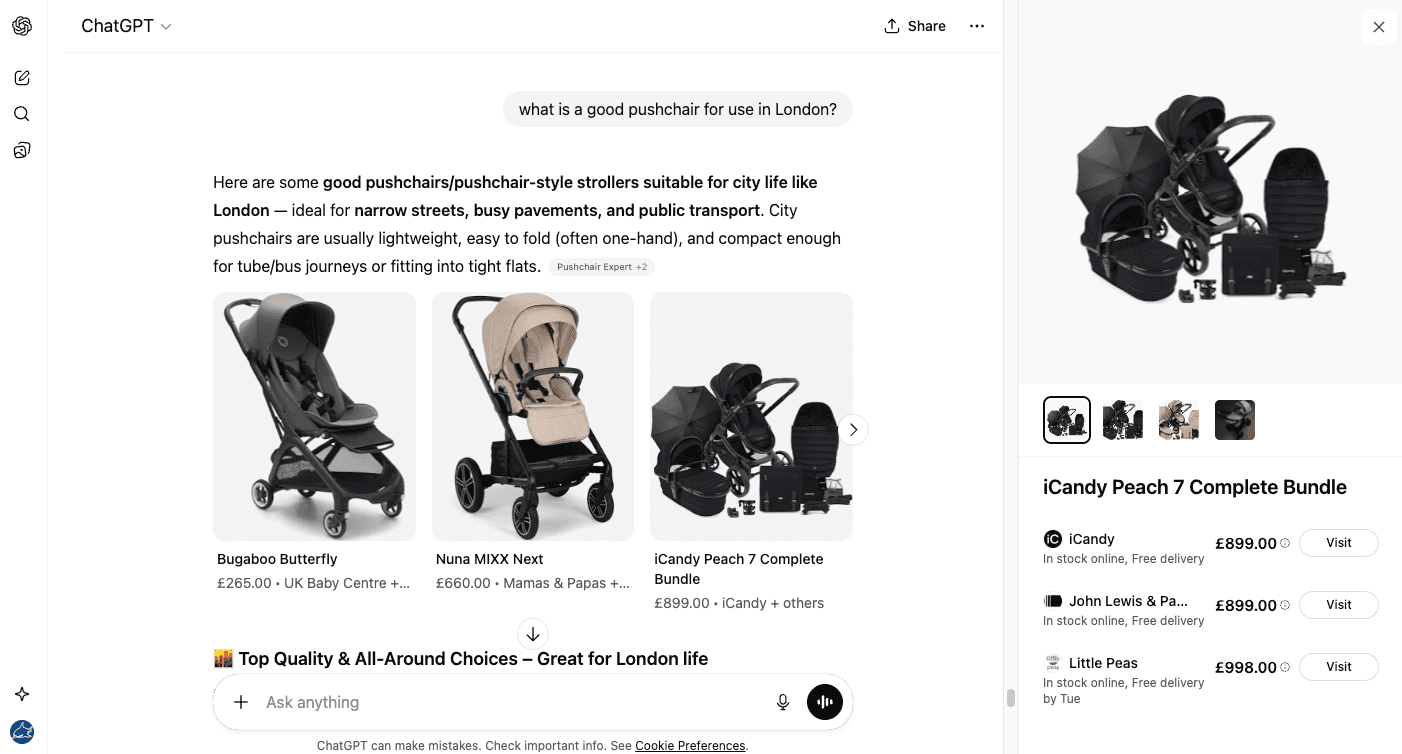
When a shopper asks an AI assistant something like: “What is a good pushchair for use in London?"...
They are no longer presented with a list of links. Instead, AI agents return rich product cards directly in the conversation, complete with images, pricing, availability, and merchant details.
Checkout entirely inside the conversation
Once the shopper taps Buy, the entire checkout flow stays inside the chat interface. There are no redirects and no external pages to load. The AI confirms:
Shipping address
Payment method such as card on file, Apple Pay, or Google Pay
Full order summary including taxes and delivery
Payments are handled using a Shared Payment Token model. The AI generates a one-time token tied to the specific order, which is passed to Shopify to complete the transaction securely. Instant checkout in the UK is still rolling out, but we would expect to see something like this:

Order lifecycle after purchase
After checkout, everything works as it does with traditional ecommerce:
Shoppers receive confirmation in the conversation
Standard order confirmation emails are sent
Orders appear in ChatGPT settings under Orders
Fulfilment, tracking, returns, and support follow existing workflows
Behind the scenes, Shopify handles the order just like any other, with the AI acting as the front-end experience rather than the merchant itself.
Why agentic commerce matters for brands and agencies
For brands already on Shopify, agentic commerce unlocks a new demand channel with minimal operational overhead. Products can be surfaced by AI even when direct checkout is disabled, and when enabled, transactions flow cleanly into existing reporting, fulfilment, and optimisation workflows.
For brands not using Shopify, the Agentic Plan provides access to AI shopping surfaces without requiring a platform migration. Product data can be uploaded, and orders can be routed into existing OMS, ERP, or fulfilment systems.
For agencies, this shift creates new opportunities around product data strategy, feed optimisation, AI channel readiness, and performance measurement. Success in agentic commerce is not just about ads or UX, but about how well a brand’s data and systems are prepared for AI-native buying.
Practical considerations
Data quality as a growth lever
Certain product fields play an outsized role in AI discovery and recommendation:
Clear titles and identifiers like SKU and GTIN
High-resolution, accurate imagery
Inventory and availability signals
Detailed attributes and variants
Transparent shipping and return policies
As AI agents generate responses in natural language, data completeness directly affects visibility and conversion.
Integration and control
Shopify supports routing agentic orders into existing systems, allowing brands to adopt this model without disrupting operations. Merchants also retain control over:
Which AI channels they participate in
Which products are eligible for instant checkout
How policies and delivery expectations are presented
This flexibility is especially important for international brands operating across multiple regions.
Pricing and current limitations
Shopify has not yet published full pricing details for the Agentic Plan. Early signals suggest that AI platforms themselves may apply transaction fees, often as a percentage of order value, separate from Shopify subscriptions. These fees vary by AI partner and are still evolving. There are also early-stage limitations:
Single-item checkout is supported first, with multi-item carts planned
Initial rollout focused on the U.S., with international expansion underway
Merchants must meet feed and checkout requirements to participate
Final thoughts
Agentic commerce is moving fast, and the decisions brands make now around data, platforms, and AI channels will shape how discoverable and competitive they are in the years ahead. If you would like to explore what Shopify’s agentic commerce roadmap means for your brand, or discuss how to prepare your product data and systems for AI-driven selling, get in touch. We would be happy to talk it through.

Chris has over 25 years of experience delivering commercial website builds across both agency and client-side teams. He specialises in performance-driven front-end development, with a strong emphasis on clean, scalable, and maintainable code.
His primary focus is Shopify, where he works extensively on custom theme development, advanced theming using Liquid, Shopify Functions, integrations with third-party systems, and bespoke app development to support complex commerce requirements.
Chris is passionate about writing well-structured, accessible code and creating websites that perform seamlessly across devices.