

I see this again and again after a replatform. A brand comes off Magento onto Shopify, the running costs drop, the site feels quicker than it has in years, and it's tempting to think the job's done, everything’s sorted and they don't need to keep investing in site speed. Google's Core Web Vitals report comes back green, and that looks like the end of the job.
There's usually a good reason to replatform, and whether to do it at all versus optimise what you've got is its own question which we've covered separately. But what happens after the move, once the dust settles and the dashboard says you’ve passed? Because that should be the starting line, not the finish.
What Google measures (and what it doesn’t)
A pass tells you less than you think. Google's Core Web Vitals grade your pages on a traffic light system: red, amber or green, with green as the top band. Your site gets a green score when 75% of loads hit Google's "good" threshold, which means a green is only ever speaking for three quarters of your traffic. The other quarter, the people who had a slower experience, don't show up in the pass at all. On a small site you can round that off. On an ecommerce site doing real volume, 25% of visits is a serious number of buyers getting a worse experience than your dashboard is letting on, and slower pages don't convert as well.
Brands see the green light, think "good, we're passing," and stop. But passing is the floor. It's the bare minimum we'd expect any of our Shopify sites to clear, not the target. The real question is how much further can you go once you're there?
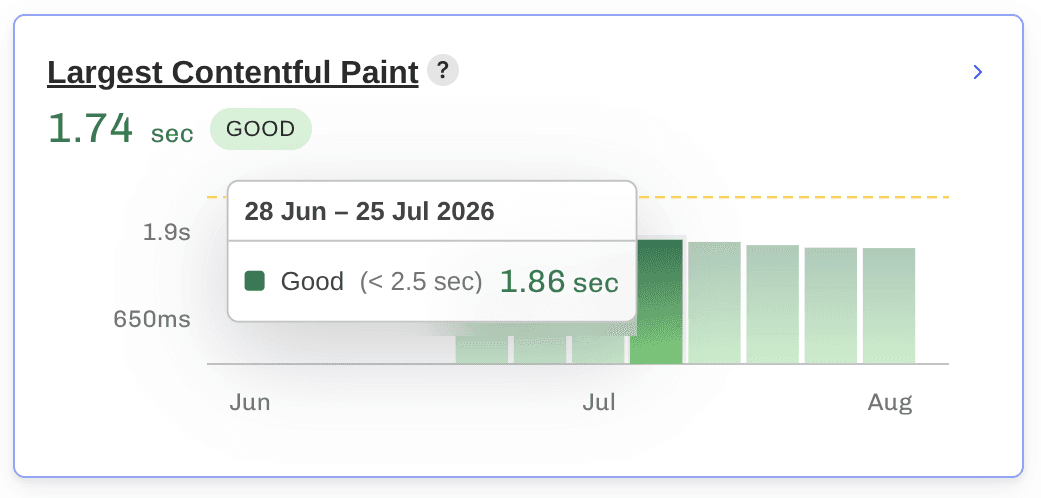
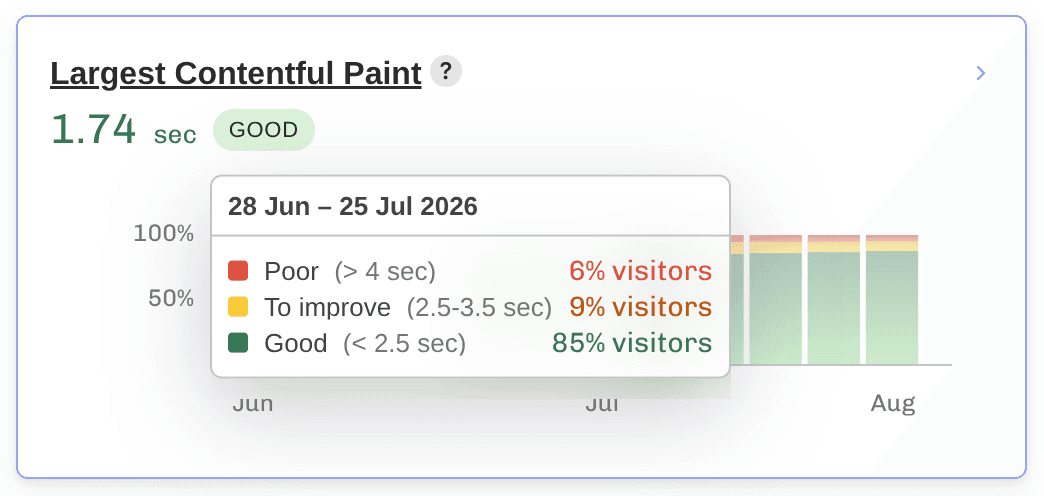
We use CalibreApp to analyse the full picture. For one site we monitor, according to Google's Core Web Vitals its LCP passed comfortably, but in reality only 85% of visitors were in the good band. 9% needing improvement and 6% were getting a poor experience.
How to push past the baseline
Asset weight is the big one. Ecommerce sites lean hard on images and video, and every one of those is weight the browser has to carry. The job is getting them as light as they'll go without wrecking the experience. There's a balance to hold, because a page that's nothing but text will load in a blink and it'll also be a miserable thing to shop on.
Third-party scripts are the other one, and they're sneakier. Klaviyo, Trustpilot, Hotjar, every review widget and analytics tag and heatmap tool earns its place on its own terms. But each one is code the browser has to fetch, parse and run, and the browser can only do so much at once. While it's busy running someone else's tracking script, it isn't responding to your shopper. So the cost isn't abstract clutter. You see it when someone taps “add to basket” and there's a pause before anything happens. The problem I run into most often isn't any single tool, it's the pile-up. Sites carrying a whole stack of scripts, some of which nobody has looked at in months, competing for the browser's attention at once. The one that comes up most is a tracking or analytics tool, like Hotjar or Clarity, still loading on every page while nobody is really looking at the data it gathers. If no one is using it, it should be turned off but it usually isn't.
A worthwhile audit
Go through everything your site loads and be honest about what's still pulling its weight:
What's sitting in your tag manager, and do you even remember adding all of it
Which of those tags are still earning their place, and which just never got removed
What's loading on every page site-wide when it only needs to fire on one
To be clear, a pass doesn't mean your site is broken. It means you've cleared the bar Google sets, and that's a good thing. It just isn't where the work ends. On an ecommerce site, the difference between “passing” and “fast for everyone” shows up in your conversion rate, and that's revenue sitting there waiting for you.
If you'd want a hand with auditing your site, it's the kind of thing we do.

I lead our development team on wide range of projects - from Magento 2 storefronts using Hyvä, to bespoke Shopify builds and fully custom headless applications. I’m passionate about combining clean code with thoughtful design to create seamless user experiences and scalable digital products.